What Is Cryptocurrency? A Simple Guide to the Technology Behind Crypto
A plain-English look at the networks, digital assets and software reshaping how value moves online.

Cryptocurrency can seem complicated from the outside. There are blockchains, wallets, private keys, tokens, smart contracts, miners, validators, gas fees, exchanges and enough acronyms to make a newcomer wonder whether everyone else got a manual they missed.
The basic idea is much simpler.
Cryptocurrency is a form of digital value that uses cryptography and computer networks to record transactions and ownership. Unlike traditional money, which is generally issued and managed through governments and financial institutions, many cryptocurrencies operate on decentralized networks. No single company necessarily controls the ledger.
That does not mean crypto replaces banks or governments. It does not. And cryptocurrency is not one single technology or asset class. Bitcoin works differently from Ethereum. A stablecoin works differently from an NFT. A blockchain used for payments can have very different design goals from one built for decentralized applications.
To understand crypto, start with the technology underneath it.
Blockchain: The Shared Record
Think of a blockchain as a public record book. In a traditional financial system, a bank maintains its own records. When money moves from one account to another, the bank updates its database.
A blockchain takes a different approach. The ledger is maintained across a network of computers.
Participants use the network's rules to verify transactions and agree on the state of the ledger. Ethereum describes its blockchain as a shared database that is maintained across a distributed network. Transactions and other data are grouped into blocks, which are linked together using cryptographic techniques.
The word blockchain comes from this structure: blocks of data are linked in sequence.
A simplified version looks like this:
Block 1 → Block 2 → Block 3 → Block 4 → Block 5
Each new block builds on the history that came before it. That makes changing old records difficult, particularly on large, well-secured networks. But "immutable" should not be treated as meaning that no blockchain record could ever be changed under any circumstances. The practical resistance to alteration depends on the network's design, consensus mechanism and security.
Why Blockchain Matters
The important change isn't simply that records are digital. Banks, payment companies and governments have maintained digital databases for decades. The more interesting idea is shared control of the record.
Instead of asking one institution to maintain the definitive database, a blockchain network allows multiple independent participants to maintain and verify a common record according to a set of rules. That can reduce the need for certain intermediaries. It can also introduce new problems.
A decentralized system may be harder to change. Transactions can be difficult or impossible to reverse. Network fees can rise when demand increases. Software bugs can have financial consequences. Decentralization is not a magic word. It is a design choice involving trade-offs between factors such as security, scalability, efficiency and control.
Bitcoin: Where Modern Cryptocurrency Began
Bitcoin is the starting point for understanding cryptocurrency. In 2008, a person or group using the name Satoshi Nakamoto published the Bitcoin white paper, proposing a peer-to-peer electronic cash system that could allow payments to move directly between participants without relying on a financial institution as the intermediary.
The Bitcoin network went live in January 2009. Bitcoin introduced a combination of technologies and economic incentives that allowed participants to maintain a shared transaction history without a central authority controlling the network. Its native asset is bitcoin, commonly abbreviated as BTC.
Bitcoin's design is relatively focused. It is primarily concerned with transferring and securing its native digital asset. Ethereum took a broader approach.
Ethereum: A Blockchain That Runs Programs
Ethereum launched in 2015. Its native asset is ether, or ETH. But Ethereum is more than a cryptocurrency. It is a programmable blockchain platform.
Developers can deploy software called smart contracts onto the network. These programs can hold assets, enforce rules and interact with other contracts. That opened the door to applications that could operate using blockchain infrastructure.
Think of Bitcoin as a specialized financial network. Ethereum is more like a general-purpose computer network whose state is shared across participants. Ethereum's documentation describes smart contracts as programs that run on the Ethereum blockchain and execute according to their programmed rules.
Bitcoin vs. Ethereum
| Bitcoin | Ethereum | |
|---|---|---|
| Native asset | BTC | ETH |
| Primary design | Peer-to-peer digital money | Programmable blockchain platform |
| Smart contracts | Limited scripting | General-purpose smart contracts |
| Consensus | Proof-of-work | Proof-of-stake |
| Major uses | Monetary asset, payments | Applications, assets and transactions |
Neither network is simply a "better version" of the other. They were designed with different priorities.
Cryptography: The Lock and Signature System
The word cryptocurrency comes from cryptography, the science of securing information. One of the most important concepts in crypto is the use of public and private keys.
- A public key can be shared.
- A private key must be kept secret.
A useful analogy is a mailbox. Your public address is like the address printed on the outside. People can use it to send something to you. Your private key is more like the key that gives you control over what is inside.
In blockchain systems, cryptographic signatures allow someone controlling a private key to authorize transactions without publishing the private key itself. This is one reason private-key security matters so much.
If someone gains control of your private key or recovery credentials, they may be able to move your assets. And unlike a bank transfer, a blockchain transaction often cannot simply be recalled because you called customer service.
Your Crypto Wallet Doesn't Actually "Store" Coins
This is one of the first concepts that surprises newcomers. A crypto wallet generally doesn't hold cryptocurrency inside it like a physical wallet holds banknotes. The blockchain records the relevant balances or ownership.
The wallet manages the cryptographic keys used to authorize transactions. There are several types of wallets. Software wallets run on computers or phones. Hardware wallets store key material in dedicated physical devices.
Custodial wallets or exchange accounts allow a third party to manage the underlying keys on the user's behalf. That creates an important distinction:
- Self-custody means you control the keys.
- Custody means another party controls them for you.
Self-custody gives users greater direct control but also greater responsibility. Lose the credentials required to recover your wallet and there may be no central institution capable of restoring access.
Custodial services shift some of that responsibility to another party, but introduce counterparty risk.
What Is a Crypto Transaction?
A cryptocurrency transaction is essentially an instruction to change the state recorded by a blockchain. Suppose Alice wants to send Bob 0.01 ETH. Alice's wallet creates a transaction.
Her wallet signs it using the relevant private key. The transaction is broadcast to the Ethereum network.
Network participants check whether the transaction is valid. If it passes the network's rules, it can be included in a block. Once the transaction is included and reaches the network's required level of finality, the blockchain reflects the transfer.
The process happens through software and network participants rather than a bank employee manually approving the payment.
What Is Consensus?
A blockchain needs a way for its participants to agree about the valid state of the network. That is where consensus mechanisms come in. Two of the best-known approaches are proof-of-work and proof-of-stake.
Proof-of-Work
Bitcoin uses proof-of-work. Miners compete to perform computational work and propose valid blocks. The process requires significant computing resources and electricity. The security model makes rewriting Bitcoin's transaction history increasingly expensive as more blocks are added.
Proof-of-Stake
Ethereum uses proof-of-stake. Instead of relying on miners competing through computational work, Ethereum uses validators that stake ETH and participate in the consensus process. Validators can be rewarded for honest participation and penalized for certain forms of misconduct.
The difference matters because consensus isn't simply a technical detail. It is part of how a blockchain protects itself against attacks and coordinates thousands of independent participants.
What Are Tokens?
A token is a digital asset represented on a blockchain. Not every token is a cryptocurrency in the same sense as Bitcoin. Some tokens represent utility within an application. Some can represent governance rights. Some represent digital collectibles. Some are designed to track the value of another asset. And some are simply speculative assets.
Ethereum's ecosystem, for example, includes standards that allow developers to create fungible tokens and non-fungible tokens. This distinction gives us another useful analogy. The blockchain is the infrastructure. The token is an asset operating within that infrastructure. But the relationship can be more complicated than that. A blockchain's native asset is part of the network itself, while a token created through a smart contract may depend on another blockchain.
Stablecoins: Digital Dollars and Other Stable-Value Assets
One of the largest categories in crypto is the stablecoin. Stablecoins are designed to maintain a relatively stable value, often by referencing a fiat currency such as the U.S. dollar. That makes them useful for people who want to move dollar-denominated value using blockchain infrastructure.
But stablecoins aren't identical. Their designs can differ significantly. Some are backed by reserves. Some use other crypto assets as collateral. Some use algorithms or other mechanisms to attempt to maintain their target value. The structure matters.
A stablecoin's name does not guarantee that it will always trade at exactly its intended price.
For users and investors, questions about reserves, redemption rights, collateral, governance and legal structure can be more important than the marketing.
DeFi: Financial Software on Blockchains
DeFi, short for decentralized finance, refers broadly to financial applications built using blockchain networks and smart contracts. Traditional finance often relies on institutions to hold assets, match buyers and sellers, provide loans and maintain records. DeFi attempts to reproduce some of these functions through software and blockchain-based protocols.
A decentralized exchange, for example, can allow users to trade assets through smart contracts rather than placing an order with a traditional centralized exchange. Other protocols offer lending, borrowing, derivatives and other financial services. The important point is that removing an intermediary does not remove risk. Instead, some risks move elsewhere.
A bank may have compliance departments, customer support and fraud controls. A DeFi protocol may instead depend on smart-contract code, economic incentives, blockchain infrastructure and external data systems. A software bug can therefore become a financial problem.
NFTs: When Digital Assets Are Not Interchangeable
NFT stands for non-fungible token. "Non-fungible" means that one unit is not necessarily interchangeable with another identical unit. A $1 bill is designed to be interchangeable with another $1 bill. An NFT can be individually distinguishable.
NFTs have been used for digital collectibles, memberships, tickets, gaming assets and other applications. There is an important misconception to clear up, though. Buying an NFT does not automatically mean you own the copyright to an associated image. The token and the intellectual-property rights attached to an underlying work are separate questions. What the NFT represents depends on the project's design and legal terms.
Gas Fees: Paying the Network
Blockchains need resources. Computers must process transactions. Validators or miners must participate in securing the network. Data must be stored and transmitted. Many networks therefore charge transaction fees.
On Ethereum, these fees are commonly described using the term gas. Gas measures the computational work required to execute operations on Ethereum. Users pay for that work using ETH. Think of gas like paying for computing power. A simple transaction may require relatively little. A complex smart-contract interaction can require more. And when many people compete for limited block space, fees can rise. This is one reason blockchain scalability matters.
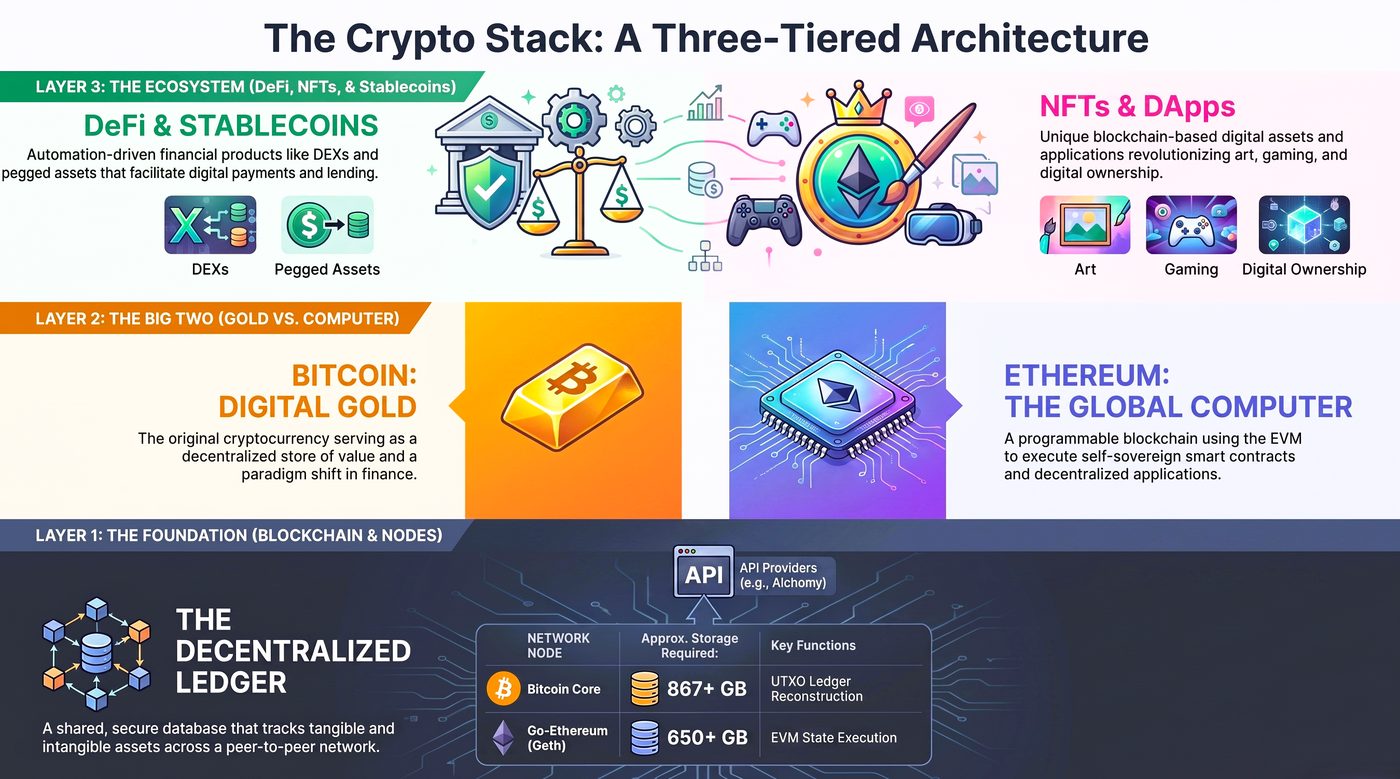
The Developer's View
To a developer, crypto looks less like a collection of coins and more like a new software stack.
A simplified blockchain application might involve:
Wallet
Manages keys and signs transactions.
↓
Application
The interface users interact with.
↓
Smart contract
The blockchain-based program enforcing application rules.
↓
RPC
The connection between the application and blockchain infrastructure.
↓
Node
Software participating in the blockchain network.
↓
Blockchain
The distributed system recording state and transactions. For more sophisticated applications, developers may also use indexing services, APIs, development frameworks, testing tools, security libraries and off-chain databases. The user might only see a website. Behind it could be an entire infrastructure layer. That is why crypto is also a software-engineering field.
What Does "Decentralized" Actually Mean?
This word gets thrown around too easily. Decentralization is not binary. A network can be decentralized in one dimension and relatively centralized in another.
For example, a blockchain may have thousands of independent nodes but depend heavily on a small number of infrastructure providers. An application may use decentralized smart contracts while maintaining a centralized website.
An asset may exist on a public blockchain while being issued or controlled by a centralized organization. So when someone says a project is "decentralized," the useful question is:
Decentralized where?
Who runs the nodes?
Who validates transactions?
Who controls the upgrade process?
Who can change the smart contracts?
Who controls the front end?
Who controls the assets or reserves?
Who can freeze funds?
The answers reveal much more than the label.
Why Does Crypto Have Value?
This is where technology meets economics. A cryptocurrency's market price is not guaranteed by the fact that a blockchain exists. Value can come from different sources.
A network may be useful.
An asset may be scarce under its protocol's rules.
Users may demand it to pay transaction fees.
Investors may treat it as a speculative asset.
A token may provide access to a service.
An asset may be backed by reserves or linked to another form of value.
Different assets therefore require different analysis.
Bitcoin's monetary design is different from ETH's role in Ethereum.
A stablecoin is different from a governance token.
An NFT is different from both.
Calling all of them "crypto" is convenient, but it hides important differences.
The Risks Are Part of the Technology
Crypto's biggest attractions often come with corresponding risks.
Self-custody gives you control, but losing your keys can mean losing access.
Irreversible transactions can reduce certain forms of fraud, but a mistaken transfer may be impossible to undo.
Open smart contracts allow anyone to inspect and interact with them, but vulnerabilities can be exploited.
Open markets provide access, but prices can be extremely volatile.
Permissionless systems can allow broad participation, but they can also make scams and malicious applications easier to deploy.
The technology does not distinguish automatically between a sophisticated investor and a teenager who has just downloaded a wallet. That responsibility falls partly on the user. The U.S. Commodity Futures Trading Commission warns that virtual currencies can be highly volatile and that users should understand the risks before participating.
Crypto Is Not Just About Coins
The easiest mistake is to think crypto means watching a price chart and waiting for the number to go up. That is only one part of the ecosystem. At the bottom is infrastructure. Above it are blockchains.
Then come assets and tokens. Then smart contracts and applications. Around them sit exchanges, wallets, developers, infrastructure providers, investors, institutions and users.
The Crypto Stack
PEOPLE
Users | Developers | Investors | Institutions
↓
APPLICATIONS
DeFi | Games | Marketplaces | Social | Payments
↓
SMART CONTRACTS
Programs that execute blockchain-based rules
↓
DIGITAL ASSETS
BTC | ETH | Stablecoins | NFTs | Other tokens
↓
BLOCKCHAINS
Bitcoin | Ethereum | Other networks
↓
INFRASTRUCTURE
Nodes | Validators | RPCs | Indexers | Wallets
↓
CRYPTOGRAPHY + CONSENSUS
The mechanisms that help secure and coordinate the system
The Big Picture
Cryptocurrency is easier to understand when you stop treating it as a single thing.
Bitcoin is not Ethereum.
ETH is not an ERC-20 token.
A stablecoin is not the same as a decentralized cryptocurrency.
An NFT is not simply a picture.
A wallet is not a bank account.
A blockchain is not just a database.
And decentralization is not an on-or-off switch.
The common thread is the use of cryptography, networks, software and economic incentives to create systems for recording and transferring digital value.
For a newcomer, that's enough to build the foundation.
The next layer goes deeper.
How does Bitcoin mining actually work?
Why does Ethereum need gas?
What exactly does a private key do?
How do stablecoins maintain their value?
How does a decentralized exchange work?
What makes a token valuable?
Why do blockchain fees rise?
Can blockchains really replace parts of traditional finance?
Those are separate questions.
And each one opens another part of the machine.
Crypto isn't a single technology waiting to be understood.
It's a stack.
Once you can see the stack, the jargon starts to make sense.